
What Is the Difference Between Minoxidil Foam and Solution?
Hair thinning and pattern hair loss can affect both men and women, and topical minoxidil is one of the most widely used treatments for certain types of hair loss. It is available in different formulations, with minoxidil foam and minoxidil solution being two common options. Although both contain the same active ingredient, they differ in their formulation, texture, application experience, and the way they may affect the scalp.
Choosing between minoxidil foam and solution is not simply about which one is stronger. The concentration, formulation, frequency of use, scalp sensitivity, and individual response can all matter. Understanding these differences can help you have a more informed conversation with a healthcare professional and choose a formulation that fits your routine.
What Is Minoxidil?
Minoxidil is a topical medication used to help stimulate hair growth in people with certain types of hair loss, particularly androgenetic alopecia, also known as pattern hair loss. It is available in different strengths and formulations, including liquid solutions and foams.
The exact way topical minoxidil promotes hair growth is not completely understood, but it is believed to influence the hair-growth cycle and help prolong the growth phase of hair follicles. Research has established topical minoxidil as an important treatment option for pattern hair loss.
Results do not normally happen immediately. Hair growth is a gradual process, and consistent use is generally important. Some people may also experience temporary increased shedding when beginning treatment.
What Is Minoxidil Solution?
Minoxidil solution is the traditional liquid form of topical minoxidil. It is commonly applied directly to the scalp using a dropper or another measured applicator.
Many conventional minoxidil solutions contain ingredients such as alcohol and propylene glycol. These ingredients help dissolve and deliver minoxidil to the scalp. However, propylene glycol can cause irritation or allergic contact dermatitis in some people. Possible symptoms include itching, redness, dryness, burning, and scaling.
The liquid formulation can spread easily over the scalp, especially when the hair is separated to expose areas where thinning is occurring. However, some users find that solutions can feel wet, sticky, or leave residue on the hair.
What Is Minoxidil Foam?
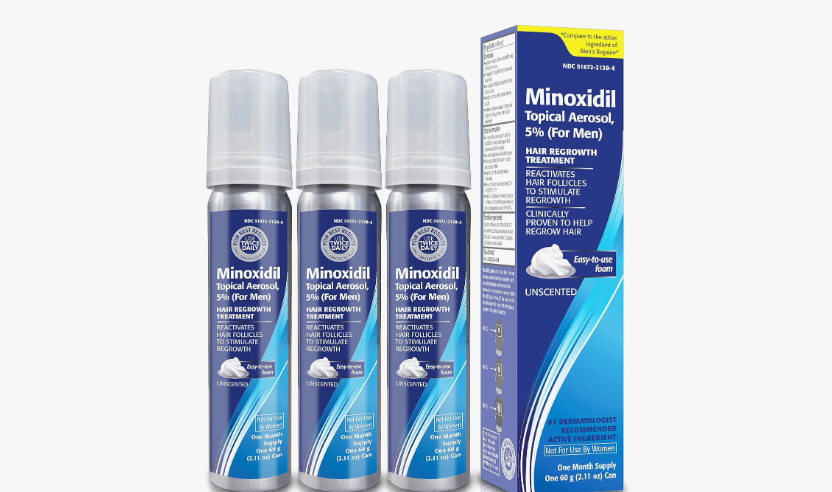
Minoxidil foam is another topical formulation designed to deliver minoxidil to the scalp. Instead of a liquid solution, the product comes out as a foam that is applied directly to the affected scalp area.
One important difference is that many 5% minoxidil foam formulations are propylene-glycol-free. This can make foam a useful alternative for people who experience irritation associated with propylene glycol-containing solutions. However, a person can still react to minoxidil or another ingredient in a particular foam, so irritation should not automatically be assumed to come from propylene glycol.
Foam also tends to dry relatively quickly and may be preferred by people who dislike the wet feeling associated with liquid products.
Minoxidil Foam vs Solution: Main Differences
The biggest differences between minoxidil foam and solution relate to the formulation and user experience rather than simply the active ingredient.
A conventional solution may contain water, alcohol, and propylene glycol, while many foam formulations use a different vehicle and do not contain propylene glycol. This difference can be important for people with sensitive scalps.
Foam is also generally easier for some people to incorporate into a daily hair-care routine because it dries quickly and is less likely to drip. In a clinical study involving women with androgenetic alopecia, once-daily 5% minoxidil foam was found to be noninferior to twice-daily 2% solution for the studied outcomes, while participants reported fewer local intolerance issues with the foam.
However, these results should not be interpreted as meaning every foam product is automatically more effective than every solution. Different products can have different concentrations, instructions, and inactive ingredients.
Which One Works Better: Foam or Solution?
A common question is whether minoxidil foam works better than minoxidil solution. The answer is not completely straightforward.
Both formulations can deliver topical minoxidil, and clinical evidence supports topical minoxidil as a treatment for pattern hair loss. However, effectiveness can depend on the concentration, formulation, correct application, consistency, and individual response.
For example, research comparing 5% foam with 2% solution in women with androgenetic alopecia found that once-daily 5% foam was noninferior to twice-daily 2% solution after 24 weeks. The foam group also reported fewer local intolerance problems in that study.
Therefore, rather than asking which formulation is universally better, it can be more useful to consider which formulation you can apply correctly and consistently while tolerating it comfortably.
Is Minoxidil Foam Better for Sensitive Scalps?
Minoxidil foam may be an option for people who develop irritation from propylene glycol-containing minoxidil solutions. Propylene glycol is a common ingredient in traditional liquid formulations and has been associated with contact dermatitis in some users.
Because many 5% foam products are formulated without propylene glycol, they may reduce irritation related specifically to that ingredient.
However, sensitive skin can react to several different ingredients. If you develop persistent redness, severe itching, swelling, burning, or a rash after applying minoxidil, stop using the product and speak with a healthcare professional rather than simply switching formulations without advice.
Is Minoxidil Solution Easier to Apply?
For some people, yes. The liquid can be measured with a dropper and applied directly to specific areas of the scalp. This can be helpful when you want to target particular thinning areas.
However, the solution may run or drip if too much is applied. Alcohol-containing formulations may also feel drying for some people.
The best application method depends on the product’s instructions. Always follow the directions supplied with the specific minoxidil product rather than assuming that all formulations should be used in exactly the same way.
Is Minoxidil Foam Easier to Use?
Many users prefer foam because it can be applied directly to the scalp and usually dries faster than a liquid formulation. Studies have also reported favorable cosmetic and practical characteristics with foam, including less dripping and easier integration into hair styling routines.
This can be particularly useful for people who need to use topical treatment regularly and want something that fits into their normal morning or evening routine.
Consistency matters because topical hair-loss treatments generally require ongoing use to maintain their effects.
Does Minoxidil Cause Side Effects?
Like any medication, topical minoxidil can cause side effects. Common local reactions can include scalp itching, dryness, redness, burning, scaling, or irritation. Some people can also experience unwanted hair growth outside the intended treatment area.
Temporary increased shedding can also occur when treatment begins. This can be concerning, but it may occur as hair follicles transition through the growth cycle.
More serious reactions are uncommon, but symptoms such as chest pain, rapid heartbeat, dizziness, swelling, or significant unwanted effects should be discussed promptly with a healthcare professional.
Can Minoxidil Foam and Solution Be Used Interchangeably?
Not necessarily. Even though both products contain minoxidil, their concentrations, inactive ingredients, directions, and recommended frequency may differ.
For example, one product may be designed for once-daily use while another may recommend twice-daily application. The correct amount also depends on the specific product.
For this reason, always read the product label and follow its instructions. Do not increase the amount or frequency because you think more minoxidil will produce faster results.
Which Minoxidil Form Should You Choose?
The choice between foam and solution depends on several factors.
If you have previously experienced irritation from a propylene-glycol-containing solution, a propylene-glycol-free foam may be worth discussing with a healthcare professional. If you prefer a liquid that can be measured and applied precisely to specific areas, a solution may fit your routine better.
Your hair type, scalp condition, treatment concentration, lifestyle, and ability to use the product consistently can all influence your choice.
The most important point is that there is no single formulation that is ideal for everyone. A product that feels comfortable and is used correctly and consistently may be easier to maintain as part of a long-term hair-care routine.
How Should Minoxidil Be Applied?
Application instructions vary by product, so the product label should always be followed. In general, topical minoxidil is applied to the scalp rather than simply coating the hair.
The scalp should usually be dry before application unless the product instructions state otherwise. Avoid applying more than the recommended amount, because using extra product does not necessarily improve results and may increase the risk of unwanted effects.
Wash your hands after application and avoid getting the product into your eyes or other sensitive areas. If accidental contact occurs, follow the product’s instructions for rinsing and seek medical advice if irritation continues.
How Long Does Minoxidil Take to Work?
Hair growth takes time, so patience is important when using topical minoxidil. Some people may notice changes after several weeks, while visible improvement can take several months.
Research and clinical guidance emphasize that continued treatment is generally needed to maintain the benefits. If treatment is discontinued, hair that was maintained or regrown because of minoxidil may gradually be lost.
Because individual responses vary, it is useful to monitor progress with consistent photographs taken under similar lighting and from similar angles.
Final Thoughts on Minoxidil Foam vs Solution
The difference between minoxidil foam and solution mainly comes down to formulation, ingredients, application experience, and scalp tolerability. Both are topical forms of minoxidil used for certain types of hair loss, but they are not identical products.
Minoxidil solution is a traditional liquid formulation that may contain propylene glycol, alcohol, and water. Foam formulations, particularly many 5% products, are often propylene-glycol-free and may dry more quickly. Clinical evidence suggests that foam can provide comparable treatment outcomes to certain solution regimens while offering practical and tolerability advantages for some users.